This episode
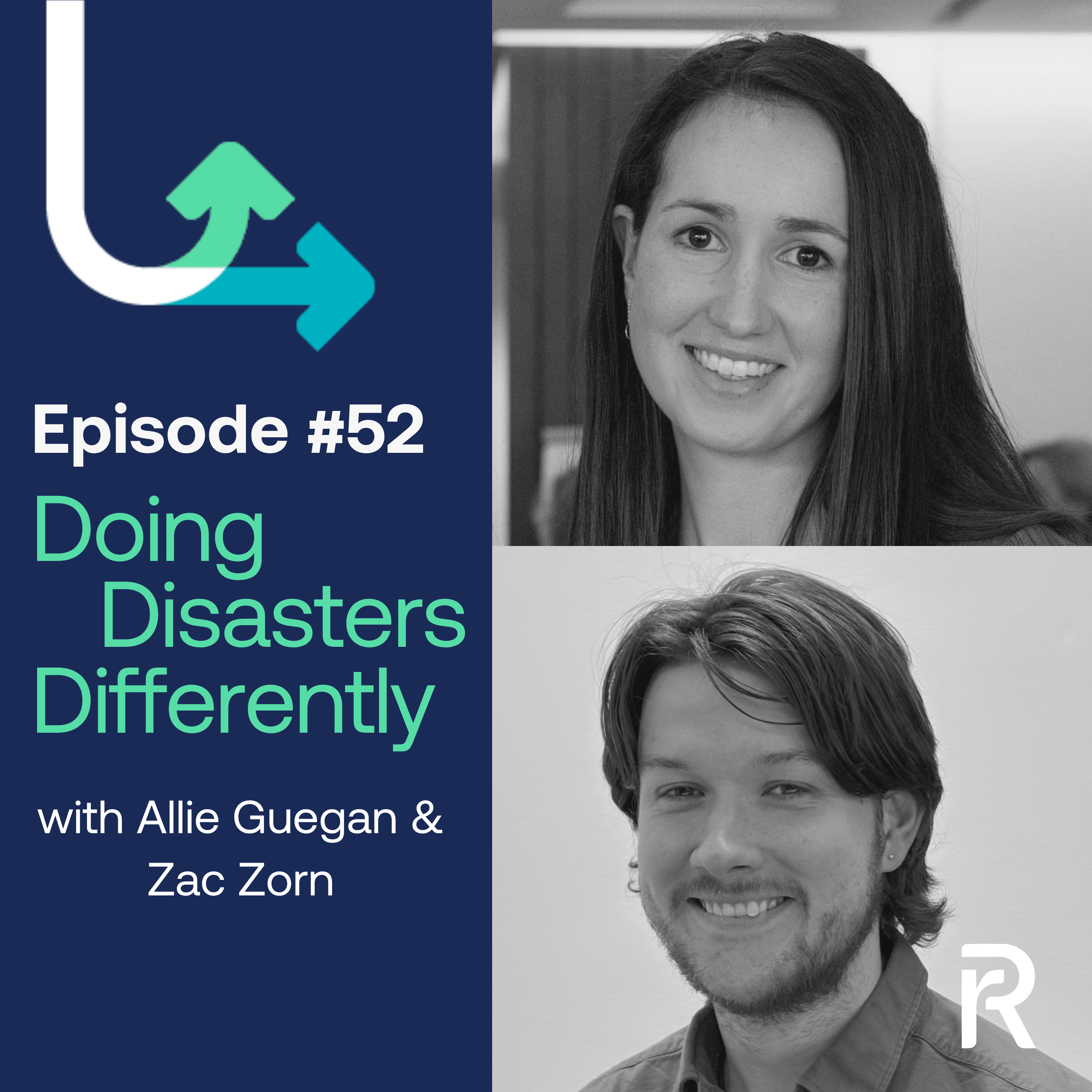
In this episode of Doing Disasters Differently: The Podcast, host Renae Hanvin speaks with Allie Guegan & Zac Zorn about Linking Council and Community.
Together, they explore innovative community resilience projects led by the City of Casey, focusing on co-design and social capital building to enhance disaster preparedness and response.
If you’re passionate about emergency preparedness, disaster recovery, community resilience, business continuity, or resilience leadership, this show is for you.
key moments from the conversation
Allie Guegan is the Head of Emergency Management at the City of Casey, leading emergency management and resilience across one of Australia’s fastest-growing councils. With more than 10 years’ experience in Victorian councils, Allie is also a volunteer fire fighter with her local brigade.
Zac Zorn is a member of Allie’s team, currently in a grant-funded project-focused role as Storm Resilience Coordinator and has a substantive role as an Emergency Management Coordinator. Zac has experience working in community recovery from both storms and floods in the Yarra Ranges and has a passion for community engagement that can drive positive social change.
My connection with the City of Casey actually goes back around 15 years, when I had the privilege of creating their internal staff brand, Simple Brilliant.
Fast forward to a couple of years ago, and our paths crossed again…this time with Allie and Zac through their roles in City of Casey’s Emergency Management Team.
One of the initiatives we’ve done together is the City of Casey Place-Based Community Resilience Project.
And I’m excited to share that project with our listeners!
1. Allie, can you please explain what does the Emergency Management Team (or EMT) at City of Casey do?
What are you responsible for and what are some of the common myths about what you are not responsible for – but people might think you are?
Allie: So people are actually really often surprised to learn that councils play such a big part of emergency management. Although we don’t lead the response to emergencies like the fire services, police, ambulance, the SES. We do play a really vital part of the before, during, and after. For our team as the emergency management team at City of Casey, we’ve got five key streams of work that we cover.
First one being our municipal emergency management planning. We do have legislated responsibilities to facilitate local level multi agency planning with all of the key agencies. So bringing together all of the emergency services, different state government departments, relief organisations like the Red Cross and Salvation Army. We bring everyone together and chair the committee and work on multi agency plans to support major emergencies within our city.
The other stream of our work is Fire prevention. So again, a lot of what we do is governed by legislation. We do a stream of work that’s under the fire services legislation that looks at again planning and preparing for bushfire emergencies in partnership with agencies and other public land managers, but also then working with private property owners around vegetation risk reduction on their property. And also ensuring that council’s managing bushfire risk on its land.
The third stream of what we do is community engagement. So that for our team is quite a breadth of activity, can range from education campaigns through to the sorts of initiatives that we’re going to speak to you a bit more about today, which is the more community resilience-based work, you know, working in partnership with community.
And then I guess the last two elements of what our team does is when there is a major emergency, you know, councils aren’t emergency service organisations, so we have to prepare all of the systems and processes and governance and then train staff around the roles that they will play during an emergency and some of the things that councils are responsible for running the relief centres. So like your evacuation centres that sometimes you see on TV when there’s major events across the country. So councils will run those. So yeah we need to do all the training and preparedness for those types of functions.
And then of course when an emergency does happen, then we respond. So emergency services will activate us and primarily what we deal with at City of Casey is smaller scale events, so typically house fires where a family might need support following, but it can then range into if there’s major floods or bushfires, yeah, running those relief centres and working alongside the emergency services to assist them.
2. As I mentioned in the intro, I created City of Casey’s internal brand campaign when they moved into central offices a long time ago – it’s called Simple Brilliant and I have to say when I was engaged to work with you on the City of Casey Place-Based Community Resilience Project that brand message rang true in how you presented the opportunity.
It wasn’t – here’s a list of what you need to do.
It was, here’s where we want to help the community get to but we want them to get there in the right way for them.
And if I can say, that’s pretty “brilliant” to me.
Can you share what the Community Resilience Project is, how it came about and why you wanted it delivered differently?
Allie: So back in 2024, our colleagues in the sustainability team developed a climate resilient Casey plan, which was quite an ambitious plan that looked at actions that right across the organisation and also in the community that could be done to support both council and the community to adapt to the impact of climate change.
So with more increasing frequency of severe weather events, we know that we need to adapt and prepare for that. And one of the actions that was assigned to the emergency management team to deliver was piloting a place-based community co-design so that we could work with community to identify ways that would strengthen their resilience to the impacts of climate change and in particular the increasing frequency and severity of severe weather events. So that action, obviously was quite broad and so we did have the opportunity to sort of from that then work out how we’re going to deliver this in the best way. And we knew from a lot of research and things that the best way to really build resilience in the community and build that social capital isn’t through doing things to the community, but with the community. And, we could have taken the approach of another education campaign, you know, developing another preparedness resource and going the community and saying, we’ve got this booklet that you can fill out and, you know, preparedness done.
But instead we really wanted to look at an approach of yeah, empowering the community because we hoped that that would lead to more sustainable outcomes where then the community would be able to continue that resilience journey themselves in their neighbourhood without council being actively involved. yeah, so that was kind of our like overarching goal going into it. We then took an approach of deciding which location. City of Casey is a pretty big municipality, so there were lots of different communities that we could have piloted it with, but one of our key priorities was to work with our community members in the coastal area, so particularly Blind Bight Warneet just because they did have some really strong social ties already within that community, being that it is a little bit of a more smaller township.
So we already had that as a foundation to build on. but also they are a community within Casey that is probably a little bit more exposed to to climate related weather events. So you know, storms, floods, bushfires. And so we definitely had them as a priority. And then we also wanted to pilot the approach with a more urbanized community because we knew that sometimes engaging them in conversations about preparing for emergencies, particularly natural hazards like bushfires, floods, storms, can be a little bit trickier because being in an urban setting, it probably is not front of mind for a lot of people living in those communities. So we decided to do the other targeted area as Hampton Park. so we sort of had that overarching goal. We knew where we wanted to pilot. and that was kind of our focus going into it. So then we engaged yourself, Renee, with Resilient Ready and we started planning how we were actually going to deliver it together. so that was kind of how we went into it.
3. I remember one of the first conversations I had, with you and Zac was about the level of participation by Council. You were so committed to this being for the community, by the community that you suggested if it’d be better for a council person to not be formally part of community sessions that’d be ok.
Which again, is pretty unique to past projects I’ve delivered.
But we collectively decided that a key part of this project was to strengthen “linking social ties” between community members and council so it was agreed that council would attend but only if the community was ok.
Why was it important for you to potentially not be there during the process to make sure the community preference was the priority?
Zac: Yeah, thanks, Renae. it was interesting for me because I’d obviously joined council around this time and was really excited to get into the project. And certainly the discussions that Ali and I had early, I think we wanted this to be as close to a true co-design process as it could be. Now I know the term co-design gets thrown around a lot these days. So certainly not going out and saying we’re gonna we’re gonna run this amazing co-design. We really wanted that like a community empowerment.
And really wanted community to be able to lead this and design this for themselves as much as was practically possible. And also I think important to acknowledge that councils are large organisations, particularly in the City of Casey, and we have many different touch points with the community. So we didn’t want any preconceived ideas or impressions of who council are and the services that we provide to influence this project negatively. So we really wanted, I suppose, give space to community and the community leaders that we were working with to self-determine what their projects were going to be and how they were going to build resilience in their communities. But yeah, probably as you said, I think that linking social capital, in that regard, I think I’m really glad that we pretty early on identified that no, it was going to be important for us to be there and be part of the discussion. Again, not us leading any discussions. That was certainly like I think we did a really good job of sitting back and letting community lead.
But was really great to be there as that supporting link and just have conversations as well. And I think over the 12 to 15 months that we were involved, just to see the evolution of the relationships that we had in both community settings was really cool for me personally. And I think went a long way to achieving the positive outcomes that we had. Probably as well just need to, build on what Ali said in response to your last question that I think we were quite lucky to have the internal support that we did. certainly the climate resilient Casey plan influencing our work. So I think as you were saying, Renae, often, you know, government councils, we have set outcomes or set agendas that we’re trying to work towards. So I think we were really lucky that we had this open-ended strategic objective that we were empowering community to lead their own journey. And I think that was really special and really contributed to the project success. But yeah, again, ultimately us being there regularly just went so much of the way to building trust and contributing to meaningful outcomes.
4. Zac, we worked with two very different community groups. And there was definitely not a one-size-fits-all approach. Can you explain the process we used for each group and what were your key learnings of the journey each group had?
Yeah, I think for me it was like, you know, to answer the last part first. The biggest learning was the value of meeting community where they’re at. Like I think we went in with a set approach around meeting monthly, but still meeting community where they’re at. Did they want to meet online? Did they want to meet in person? Like we still put that to them very early, but we still had a structure that we’re probably going to meet three to four times at the start, around project design, give them some time to go away. But I don’t think we stuck to that initial design for either of the groups, but in both settings, it went like very different paths for how we worked with them. So I think to start with the coastal villagers group, as Ali touched on, Blind Bight Warneet very early on, it was established that they wanted to meet in person, they wanted to meet regularly, and they also wanted to include Cannons Creek, a third coastal village, which was really cool to see that self-determination early on.
And then really advocating for their own communities. And we were very happy to facilitate that and yeah, open up that project scope. I think with that group, because they had such a strong sense of place and such a strong sense of community. There were community leaders that were already widely involved in their villages or broadly in the City of Casey as well, that they were really able to early on identify the need and identify what they wanted to achieve. So then it was just really working through the governance with them, helping to support them to break down some barriers to actually achieving that. Like I think we were really enabling and trying to do the heavy lifting for them. And the whole time that group had an outcome that they were trying to achieve. And you know, still today, like they’re still meeting and still working towards that independently, which is terrific. Whereas I think with Hampton Park, we probably encountered fairly early on this issue of what resilience is. And that’s probably like a a key learning as well around how we’re framing that community resilience. Because there were almost two streams that we found early on around well, what is climate resilience and then what is community resilience to severe weather or natural disasters and that sort of thing. So that was really interesting and I think a challenge that we had to overcome because how do we deliver a project that’s satisfying everyone’s interpretation of what we’re here to do. And yeah, well I guess On the one hand, we could have set stricter parameters and avoided that, but then are you compromising the co-design nature of this project? So yeah, look probably leaned on you a lot in that setting, Renae. And I think we were lucky to have your expertise there to help guide that group through a tricky situation where they were almost splintering themselves and going down different paths. So we probably at a point had to back off a bit as well and let them do that self-discovery and then come back in and work with them to achieve a more I think they ended up with probably a more tangible outcome, like a more product in a sense, which suits that probably urban community more than the coastal villages, where there’s a strong sense of place and a stronger understanding of how severe weather impacts those communities. So certainly a lot of structure to how we engaged both groups at the start, but then a more fluid approach down the end. And I think, yeah, my key reflection
Is it that it’s all about meeting community where they’re at, being flexible, trying to break down barriers for them. And as much as we talk a lot about, you know, community led, can’t be all up to them. Like we’ve sorta really come in and try to do the heavy lifting and break down those barriers.
5. Can you share what the end results were for each community group and were they what you thought they might be before we started the project?
Zac: Yeah, I think no, they weren’t what I thought they would be, to be honest. Me too. Yeah. So in our coastal villages, the participants of the program representing the three coastal villages of Blind Bight, Cannons Creek and Warneet. at the end of our engagement with them, they incorporated as a community organisation, Casey Coastal Villages Resilient Support to give them a plug on here for anyone listening.
So they’re an incorporated organisation and they launched at a community festival early this year. So they actually had the support of a few different organisations at the local Rotary Lions and CFA to come in and uplift them and launch at this community event, which was really fantastic to see. And they’re still meeting monthly now to talk about issues like community connection and resilience to future severe weather events, particularly in those communities.
storms and power outages. So that’s yeah, really fantastic to see. And while it wasn’t what I was expecting, if we if you had to have kind of pressed us at the start, Renae, on what is like an ideal case scenario, again, not wanting to impose anything on these two communities, but that probably almost is our ideal that we’ve now got a resilience group in action and doing really incredible work.
They even were up in Hillsville a few weeks ago meeting with the resilience group up there to exchange ideas. So it’s just really terrific to see.
6. I had many favourite moments from this project.
a. Watching the connection between Zac and each community group grow… alongside the community members building the confidence to take over the project reigns.
b. The pride on the faces of the community members at the community event and when handing out the stickers.
c. And when a community member asked me in a wrap up session why I didn’t go in and tell them what to do, but instead helped them grow…
The biggest moment was seeing how this project proves that resilience isn’t something councils deliver to communities but it’s something they build with them.
Allie and Zac what were your favourite moments?
Allie: I think for me, I didn’t stay actively involved in working with the community after getting the project off the ground. But I think it was a really nice opportunity at the end. I was able to come along to the final sessions with the the two groups. Zach invited me along and I guess for my role, I play that more behind the scenes of, taking the strategic actions and the other drivers for our work and then working with my team members to help support and enable them to do their best work. And it was just, this really wonderful opportunity to come along to the debrief and hear the community members reflect on this real deep appreciation for Zach and the respect that he had shown them, but also for them to feel that council had actually genuinely partnered with them. I think, yeah, just similar to what you were saying, Renae, like it really touches you. Like you do feel you walk away from that feeling quite proud of what’s been achieved.
So I think for me that was a really great moment. And probably the other one isn’t so much a moment, but more again, sort of walking away from the session and the project wrapping up is just also now and it’s a bit of what you’ve just been talking about is like these linking ties that we have. Like for these community members, yes, they’ve got these great links into council, but for us and our team, we’ve got these fantastic links into the community now. And that is so critical for our team to have because if we do in the future have a significant emergency occur, being able to go to these trusted people within the community and hear firsthand from them around what’s the concern, how we can help. it’s just really opened up this window of opportunity for us to keep building these relationships directly in the community. So yeah, those probably the two things that I most value from the project.
Zac: Yeah. Well firstly, thank you, Renae, for your generous words. I think that probably is my favourite moment as well, just being welcomed into these two community settings. I think it’s a real privilege of being a council officer, particularly like a community-facing council officer that you get to be out working in these community settings. And with both groups, sure at the start there was the hard questions asked of council.
And that’s always welcome and that’s completely fair, but to yeah break down those barriers and then be welcomed into both community settings and that hospitality shown towards like myself in you, Renae, was just yeah a real highlight and but always felt very warm and productive when we were at these meetings and it felt collaborative, which I think is yeah just fantastic. And especially considering we’re, you know, in a time and space where trust in government generally is deteriorating slower than what it has been recently so just to break down those barriers and form really trusting relationships with community is yeah just fantastic and I certainly think it’ll be a career highlight for a long time. And then beyond that just seeing both groups continue to meet in their current forms, seeing Casey Coastal Villages Resilience Support meeting as a formal incorporated group and then seeing in Hampton Park our community leaders like Karen still meeting informally.
And just the momentum that they’ve got from this project and the fact that they’re still running with it now is just, yeah, really, really terrific.
Allie: My first one would be obviously more investment in initiatives that support that social capital building and that resilience development in the community, often a lot of investment goes into the more tangible things. and building social capital is quite intangible, but obviously it leads to much more sustainable outcomes. So yeah, I would love to see more opportunity for us to do this kind of work.
I think for me the second one is probably more of a one that’s closer to heart, which is I wish more people would get involved in emergency service volunteering just because it is again another great way that you can build social capital and resilience in your community.
People are often surprised that majority of Victoria’s emergency management workforce is voluntary-based. I think last stats I saw were that there were over 100,000 emergency service volunteers and it’s just such a great opportunity not only to be part of the emergency response, but you know, it is a community within a community. It’s bringing together people from all different walks of life. it is quite different to other types of volunteering in the community. all volunteering is really valuable, but it is something that is a bit more of quite a commitment and something that’s long term for people.
so yeah, I think It is one of those things that as people’s lives get busier and society changes, it’s probably not something that is at the forefront of people’s minds as much anymore. But if the if I could wave my magic wand and make something different, I think it would be that yeah, more people could get involved in in volunteering in their local SES or CFA or Red Cross.
Zac: Yeah, just to into Ali’s first one. I remember hearing Professor Aldrich speak a couple of times now and I feel like he always speaks about particularly in Australia, we invest a lot in great infrastructure and the built environment to prepare for disasters and often that feels like it’s at the expense of our social infrastructure. so I think projects like this one are a real great example that for a fairly low cost compared to building a new something physical we can get real tangible benefit to community and for a long term as well.
So I’d love to see, as Allie said, more investment in our social infrastructure and social capital in that disaster space. And look, my second one probably links to us being on here today, but I’d love to see like emergency management, resilience, recovery. I’d love to see practitioner voices amplified more as well. I think there’s a lot of, you know, we’re a growing sector.
Connect with Allie Guegan
Connect with Zac Zorn