Insights / SOCIAL CAPITAL
Social Capital: It’s Time to Turn the Conversation into Action
By renae hanvin
Aug 24, 2026
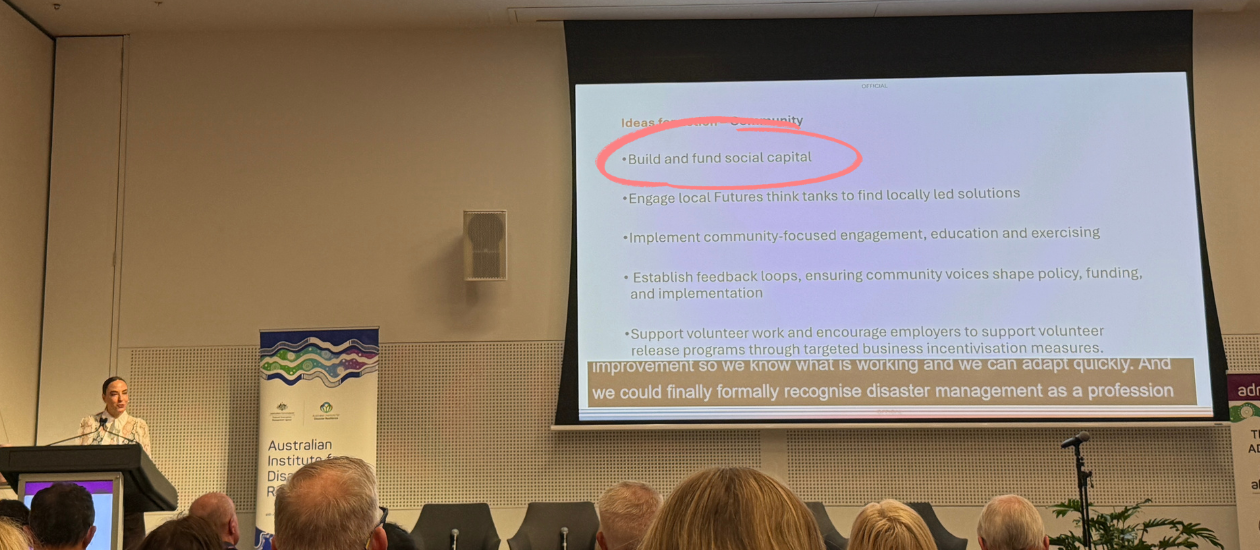
At the recent Australian Disaster Resilience Conference, one thing was impossible to miss: literally everyone was talking about social capital.
Across presentations, panels, keynotes and conversations, the importance of relationships, trust, networks and connection kept coming up. Different lenses may have been used at times, but the message was remarkably consistent in that the strength of our connections plays a critical role in how well we prepare for, respond to and recover from disasters.
For me, that was pretty exciting.
For years, we’ve been talking about social capital as our invisible infrastructure. It’s the relationships and networks between people; bonding connections with those closest to us, bridging connections across different groups and communities, and linking connections to institutions and people with access to power, information and resources.
Alongside it sits social infrastructure being the physical places and spaces that enable those relationships to form and flourish. Our community centres, parks and open spaces, places of culture and faith, and the social businesses like cafés, pubs, hairdressers and other places where people naturally meet and connect.
Together, they create an infrastructure that is every bit as important to resilience as many of the physical assets we traditionally invest in.
Knowing something matters isn’t enough
One of the highlights of the conference was Craig Foster’s keynote and his reflections on leading with integrity. A message I took from his presentation was that when we know something is right, we need to be prepared to take a step forward and act, together.
That really resonated with me because I think that’s exactly where we are with social capital.
We know relationships matter. We know trust matters. We know connected communities are better positioned when disruption occurs.
So the question is no longer simply, “Does social capital matter?”
The question is: what are we going to do about it?
Kate Retzki (in the image above) from Queensland’s Office of the Inspector-General of Emergency Management also spoke about the idea of having a “crystal ball”… being able to see what’s coming and better understand where our vulnerabilities might lie before disaster strikes.
While none of us actually has a crystal ball, better data can get us closer.
If we can see where social capital is strong or weak, where people are connected or disconnected, and where the social infrastructure that enables connection exists or is missing, we can make more informed decisions before disruption occurs.
That’s exactly why measuring this invisible infrastructure matters because it helps us move from reacting to what happened, to understanding where we can strengthen communities ahead of time.
Talk about it. Measure it. Invest in it.
The first step is to talk about it.
We need a common language and understanding of social capital and social infrastructure across governments, emergency management, communities, businesses, funders and other sectors. If we can recognise the different types of connections that exist (and the places that enable them) we can start treating them as something that can be intentionally strengthened.
And now we have descriptors – for talking about social capital and social infrastructure.
Have you seen them? Are you talking about them?
Then we need to measure it.
For too long, social capital has been described as important but intangible. Something we know exists, but struggle to see.
That’s why we developed our social capital and social infrastructure measurement approach and Sociabli® mapping platform – to make the invisible visible.
By mapping social capital and social infrastructure at a local level, we can start to understand where connections are strong, where gaps or vulnerabilities exist and, importantly, where investment could make a difference.
And then comes the most important part.
We need to invest in it.
Not just after a bushfire, flood, cyclone or other disaster when communities are already under enormous pressure. We need to invest in the relationships, networks, places and spaces that connect people before we need them.
Because social capital isn’t just important when a disaster strikes.
- It helps communities thrive every day
- It supports belonging and social cohesion
- It strengthens local businesses and organisations
- It helps information travel
- It connects people to support and resources
- It builds trust
And when something does go wrong, those existing relationships become an incredibly powerful part of how communities respond and recover.
Our greatest asset may be the one we can’t see
Coming away from the Australian Disaster Resilience Conference, I feel like the conversation has shifted. Social capital is no longer sitting on the edges of the resilience conversation. People across the sector understand its value.
Now we need to take the next step. Talk about it. Measure it. Invest in it.
Ready to join us?
Because if we deliberately build our invisible infrastructure in the good times, it may just become one of our greatest assets in the bad times.
And if you’re ready to take that step too – join us.
Let’s connect!
Resilient Ready is a social enterprise building stronger businesses, connected communities and greater resilience – before, during and after disasters. To keep updated on news and current projects, sign up to our newsletter.