Insights / SOCIAL CAPITAL
The relationships that hold recovery together: taking Sociabli to the US
By renae hanvin
Sep 29, 2026
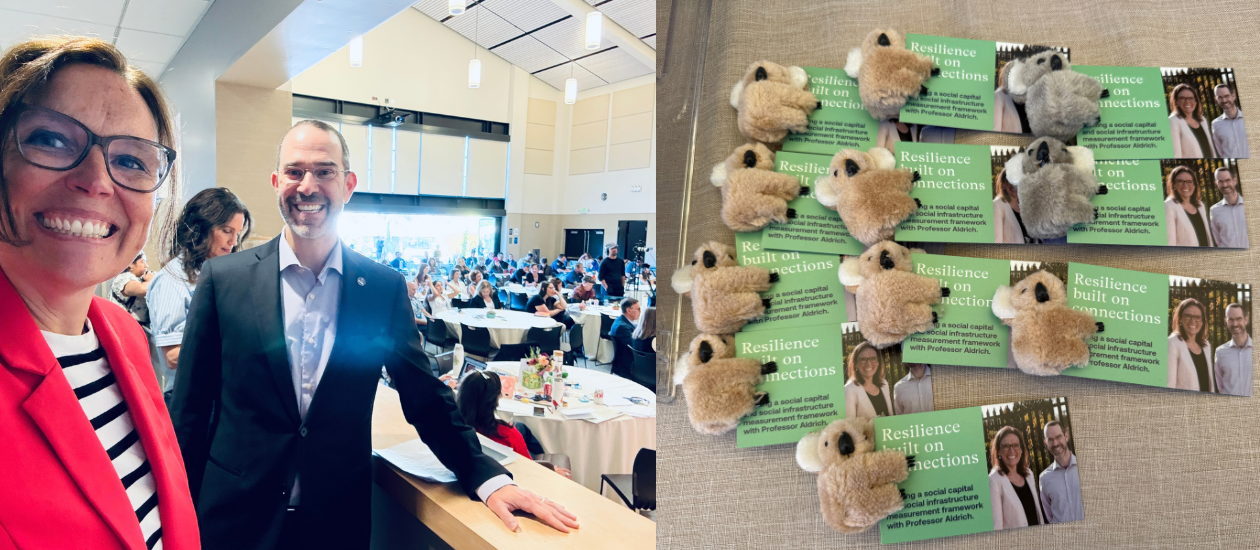
There’s nothing quite like hearing applause after showing an explainer video.
At the After the Fires Leadership Summit in the United States, I had just shown how we can map something people often describe as invisible: the connections, trust and cooperation that help communities prepare for, respond to and recover from disaster. The applause told me the idea had landed. People could see why it mattered.
I was delighted to be invited back to the summit this year. This time, I presented alongside Professor Daniel Aldrich, whose research on social capital and disaster recovery has shaped how people around the world understand resilience. Daniel and I have worked together since 2019 to connect that research with practical ways to help communities.
Our session was called The relationships that hold recovery together.
When a wildfire hits, we know to restore power, repair roads, reopen businesses and rebuild homes. Those tasks are essential. But recovery also depends on who checks on a neighbour, who shares reliable information, who knows where to ask for help and who can connect a community to decision makers.
Those relationships are social capital. They are easy to overlook in a recovery plan because they are harder to see than a damaged road or building. They also need places to grow: libraries, community centres, parks, cafés and other shared spaces where people meet and build trust in ordinary times.
That led us to a practical question: If relationships help hold recovery together, how can we see where they are strong, where they need support and whether our investments are making a difference?
What we shared from Australia
In Australia, our team has launched a National Social Capital + Social Infrastructure Measurement Framework and developed Sociabli, a tool that maps social connections and the places that support them at a neighbourhood level.
It lets us look beyond a single score. We can examine different kinds of relationships: close ties, connections across groups, and links to people and institutions with the power to help. We can also look at the shared places and spaces that give those relationships room to form.
At the summit, we showed examples from Australian communities and asked the question that matters most after any map appears on screen:
What will you do differently now that you can see connections in your community?
A map is a starting point. Local people can tell us what the data misses, which connections already work and where trust needs to be earned. From there, councils, emergency managers, funders and community organisations can make more informed choices about where to focus their effort.
They might use the evidence to identify neighbourhoods that need stronger connections before the next disaster. They might test whether a planned community facility will bring different groups together. Or they might revisit how they communicate with residents when trust in institutions is low.
The same work can help after a disaster. It can show why restoring a particular meeting place matters to a community, or help organisations track whether recovery initiatives are rebuilding connection over time.
Why engage us?
Many organisations already know that community connection matters. The harder part is deciding where to act, what to invest in and how to tell whether it helped.
That is where we can work together. We bring measurement, mapping, research and community engagement into the same conversation. We help organisations interpret what the evidence means locally, check it with the people who live there and turn it into decisions they can act on.
Our work does not begin and end with disaster recovery. The relationships and shared places that support recovery also matter for social cohesion, health, local participation and the everyday strength of a community.
Bringing this work to the US is an opportunity to explore how the Australian approach could be adapted with US partners, local data and community validation. And we’re already deep in conversations with future partners.
The applause at the summit was a lovely moment. What excites me more is what could happen next: making the relationships that matter visible, then working with communities to strengthen them before they are needed most.
Ready to join us?
The relationships we build in good times can become some of our greatest assets when times are tough. If you’re ready to make those connections visible and strengthen them, let’s work together.
Let’s connect!
Resilient Ready is a social enterprise building stronger businesses, connected communities and greater resilience – before, during and after disasters. To keep updated on news and current projects, sign up to our newsletter.