This episode
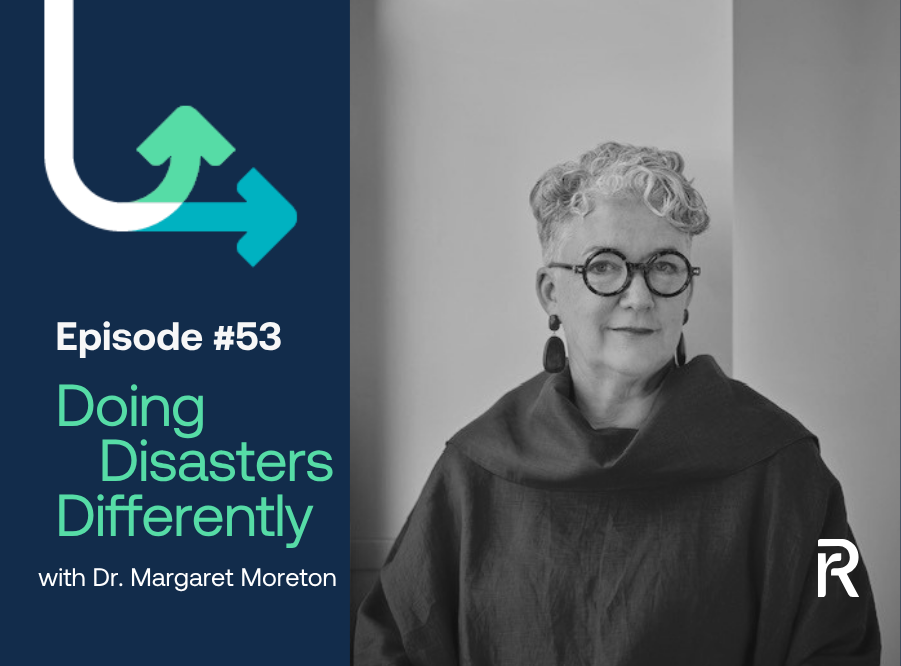
In this episode of Doing Disasters Differently: The Podcast, host Renae Hanvin speaks with Dr. Margaret Moreton about gender and disaster.
She discusses the critical importance of integrating gender perspectives into disaster management. She highlights how disasters impact different genders unequally and shares practical ways to create more inclusive, resilient communities.
Together, we explore practical insights, lived experience, and real-world strategies to help communities, businesses, governments, and leaders build stronger disaster resilience in an increasingly uncertain world.
In this episode, we cover:
- The meaning of gender and disaster
- Disasters do not discriminate, but impacts do
- The importance of inclusive disaster planning
- The role of social capital in resilience
- Addressing gender-based violence post-disaster
- Changing mindsets to embed gender considerations
- The significance of community connection and social infrastructure
- The challenge of translating evidence into policy
Subscribe now and join us as we explore smarter, stronger, and more connected ways to prepare for the future.
key moments from the conversation
Dr Margaret Moreton is the CEO of Gender and Disaster Australia and one of Australia’s leading voices on inclusive disaster resilience.
With decades of experience spanning government, community development and emergency management, Margaret has dedicated her career to ensuring that disaster planning, response and recovery work is for everyone—not just the average person.
Her work has challenged long-held assumptions about disaster management by highlighting how gender, inequality and social expectations influence people’s experiences before, during and after disasters.
Through research, advocacy and education, she continues to shape national conversations about creating emergency management systems that are safer, fairer and more effective for all Australians.
I’ve known Margaret through the emergency management sector for many years. We’ve shared a passion for looking beyond the traditional disaster lens and asking bigger questions about what really makes communities resilient.
She’s one of those people that you just want to hang out with. Always with a really robust conversation to be had.
1. What does “gender and disaster” actually mean, and why should emergency managers, councils and governments care?
Dr. Margaret Moreton:
Do you know I often get a momentary confused look? Gender and disaster, Margaret. Why, what’s that about? It’s really about understanding that intersection between a disaster we might be caught up in and our gender and whether our gender interacts with that disaster and how it unfolds and how it impacts or affects us. And you’d be surprised perhaps additional harm occurs based purely on our gender, how we perceive ourselves in our gender, perhaps even our sexuality, we could get into some really interesting conversations here Renae. And what people expect of us and what we expect of ourselves because of those things. So additional harm, whether you’re a male, a female, non-binary, whether you identify as part of the LGBTIQA plus letters sets, there’s a whole way of unpacking this.
And the reason why emergency managers, councils and governments need to care is because of this additional harm. Our safety is affected, the dignity with which we are treated through the processes that happen before, during and after a disaster. all these things are affected just because of how we understand or others understand our gender.
2. We often hear people say, “A disaster doesn’t discriminate.” But your work suggests that’s not actually true. Is that saying one of the biggest misconceptions in emergency management?
Dr. Margaret Moreton:
Do you know one of the most fun things is when we adopt a saying, and then because I think I might have said that at different points in my life, and then you realise over time, actually that’s not quite right. we first started doing some of this around, you know, natural disasters. And there’s a whole movement now which you and others would be aware of. No, no, no, disasters aren’t natural. They’re about how the natural environment interacts with people, where we live and how we live, and so on. Whole discussions about these things.
If only we weren’t into these catchy slogans, but slogans kind of capture something in a shorthand. The risk with shorthand is that we get it wrong. So disasters don’t discriminate, a fire, a flood, a cyclone, a storm. They don’t run around deciding. They have no particular, you know, intellectual capacity. But they impact people differently. So I guess we have to be careful about how we say things.
Disasters affect people differently. So whether it’s based on our gender, our age, our cultural background, whether we’re First Nations, whether we live in remote, rural, regional Australia, whether we’ve prepared, whether we’ve not prepared, whether we’re educated in general, whether we’re educated in the specifics of disaster management, all of these things will have an impact on how a disaster affects us. Often It has to do with the stereotypes that we have in mind about people based on their gender. There are a whole range of qualities that combine together to make us who we are. Gender differences have a real impact on people’s experiences before, during, or after a disaster, whether you’re invited to join a planning process, whether you have easy access to an evacuation centre, whether you’re safe in that centre.
Whether you have access to toilets. Toilets are often something I just highlight because we have examples of people being denied access to an evacuation center and denied access to toilets because they identify and explain themselves as a gender, as female. They might be trans, they might and someone will say I don’t think so. They’ll either say that in their own mind or they’ll say that explicitly. No, I’m sorry, you can’t come in here. You’re not in the right place. Or there might just be those subtle things about not feeling welcome. We’re doing a fantastic project at the moment on evacuation centres. So I’m really focused on that. And simple things like signage, signage at the front of an evacuation centre that says that you are LGBTIQA plus friendly, or all gender signs on toilets, supplies being available in evacuation centres that women might need.
Incontinent path for the elderly. There’s a whole lot of dignity and safety involved and simple things can send a message very clearly, you are welcome here or you are not. So there’s all sorts of practical ways that our gender impacts our safety and our dignity through a process. Again, mostly in those examples focused on the immediacy of the emergency.
But these things can go long after the emergency.
3. I’ve spent years talking about the importance of social capital and connected communities. You’ve spent years talking about gender and inclusion.
Where do those two conversations intersect, and what happens when communities get both right?
Dr. Margaret Moreton:
They are directly related to each other. And look, if I went to the end of that question first, in communities that do really well on both of those, you can tell by walking into a community it’s vibrant, it’s comfortable, nobody’s on the edge, everyone’s included in the activities, and you can see the mixture of people right there in front of you. Unfortunately, most of our communities don’t get this 100% right. We’re all in a process of learning at the moment.
One of the examples I like to reflect on it involves a person with quite severe disability in a crisis, and they have fabulous social capital because they actually need it on a daily basis. So they’re not waiting for a crisis to think about whether they should or shouldn’t have good connections with others. They need it on a daily basis. So there was a particular fire when I lived in Canberra, in the Canberra fires in 2003 where a particular individual ended up evacuating able-bodied people from their street and suburb because those able-bodied people hadn’t prepared. Whereas this person with a disability was very well prepared. They had plan A, B, C, D, E, F, G. And as the thing unfolded, they were able to look after others. So this whole ability to see people as having social capital and having strengths and capabilities rather than labelling someone as having fewer strengths and capabilities. You know, the older I get, one of these days I’ll turn into a little old lady. But I’ll have great social capital. If I’m lucky, that’s what I’ll do.
You know, in the area where I live, I have really good connections to various people of various ages in my area. I have chickens. Chickens are a connector. I share my eggs. I have vegetables and fruit trees. So there are lots and lots of different ways that women and LGBTIQA plus members in particular tend to have this social capital more frequently. A lot of resilience programs across this country, informal as well as formal are run by women. Women tend toward this work. I’m always nervous because I’m nervous I’ll contribute to a stereotype. But men often struggle with that social relationships, the building of that social capital. So, we’ve got to work out how to be focused on this so that we can develop this with and for everybody.
First Nations groups in Lismore I’ve got a few examples in that area. The First Nations groups and communities are often really focused on building this social capital and more and more they do that not only for their own community members, but for the other community members around them. So there’s a lot of benefits and opportunities when we bring gender and social capital together, which I think we could really do some great work on that across the nation.
4. I loved your recent message that our strongest disaster tools are preparation, care and connection. It really resonated with my work around social capital.
Do you think we’ve spent too much time planning for hazards and not enough time strengthening human relationships?
Dr. Margaret Moreton :
This is such a sitter of a question and anyone who knows me knows what I’m gonna say. So a hundred percent. Hundred percent. It is not that we don’t need to spend money and I do recognise that, collectively the system and governments and so on, there’s a limited amount of resourcing and money. But it’s not that we don’t need to invest in strong bridges and good roads.
It’s not that we don’t need those things. It’s not that we don’t need fire trucks, helicopters, so on. But there are plenty of examples and Daniel’s work highlights a number of plenty of examples where relationships, human relationships are going to be what gets people through when those other things fail. So one hundred percent we need to invest more time, more effort, more intellectual, power into these human relationships and how to expand them, how to build them, how to strengthen them, all of the different varieties. yeah, there are so many examples of where it’s people who make the greatest difference.
5. One of the hardest conversations your organisation is leading is around the increase in gender-based violence following disasters.
Why has this been overlooked for so long, and what does the emergency management sector need to understand?
Dr. Margaret Moreton:
This is a really difficult area. And when I think about why questions, there’s probably a complex set of factors about why it’s not really been looked at. It’s unpleasant. That’s the first thing. It is unpleasant. and we’re really aware in the conversations. I’m now in conversations in all sorts of places with other organisations that also work on gender-based violence in different settings, not just in disaster settings. And we’re really hoping to push for more change on this. It’s a really difficult conversation. And if you bear with me, I’d like to throw some stats at you and at your listeners just in case there’s a question of, well, what are we talking about here? The stats I’m about to give you are all available publicly. And I found a good source that anyone can check these, which is the Department of Prime Minister and Cabinet federally in the federal government. So there’s a whole study on it. One in four women, that’s 23% of us, and one in 14 men, that’s 7.3% of us, have experienced violence before the age of 15 from an intimate partner. Now, when you think about that, before you’re 15 years old. 23% of women, 7% of men. That’s appalling.
If we look at that through a First Nations lens, it gets worse. Two in three First Nations people aged 15 and over, where they talk about the physical harm they’ve had in the previous 12 months, they report that that’s through an intimate partner or a family member. Women with disability, twice as likely.
This goes on and on. Women living outside major cities, 1.5 times as likely. So we know from our own research, led through Gender and Disaster Australia, that all of that, because all of those stats are in normal times, not disastered times. We know that violence goes up to seven times higher levels of intimate partner domestic violence in communities affected by disasters.
We clearly have a problem across society. Now there are all sorts of influencing factors for that. The sheer stress of going through a crisis like a fire, flood cyclone, etc., coupled with increased uses of alcohol and drugs, coupled with all sorts of factors around gender, again. So women who are in more caring roles.
Men often go through a huge process of guilt is probably too glib, but mental health problems as a result of not being able to do what they thought a man should be able to do in terms of protecting property and family and so on. Many factors contribute to this escalation of violence. We have got to find ways to support communities and hear them about how they can help address that situation happening in their own community. And we’ve got to start talking about it before the event.
We have to plan for recovery and plan for these supports. And one of the best things that you can do to plan is connect local services with one another. So the local family services, the local domestic violence support services, the local emergency planners. Those people all have to know one another and connect before the event occurs. It’s a really difficult question. It’s a really uncomfortable discussion, but we’ve got to have it more and more.
6. You published a paper in July reflecting on 15 years of gender, disaster and climate change research and, importantly how evidence actually changed policy and practice.
Research is one thing. Changing systems is another. What’s been the hardest part of turning evidence into practice?
Dr. Margaret Moreton:
So you’re right, we’re all about the changing the system, changing the world, people like you and I, Renae. For good, of course. for good. And changing mindsets. and I think one of the hardest things to for any of us to let go of is a mindset we hold dear. So I think changing mindsets is really a challenge. And without changing it, there’s a whole area of academic discussion about do you change the mindset first or do you change the behaviour first? And I’m kind of inclined to think either or both end.
Let’s fake it till you make it or change your mind and then it’ll come naturally. Either way, I’m happy to go with it. So we’re very focused on turning what we learn and our evidence into resources that can be used you know, our training program and we are producing more and more resources, fact sheets, guidance material, hoping that this can all contribute to greater knowledge and greater mindset change. and we’re also working on how to do this up and down the system and between different sectors. So this year we’ve been developing a new module to complement our lessons in disaster training and it’s designed to be a briefing module for leaders.
Because they’re not going to come to a training day. we’re trying to be really flexible now about who’s the audience that we’re trying to reach and which part of the system do we need to move. So finding time to focus on all of this is challenging because I know everyone’s got a lot to do, but we really wanna say very, very clearly it’s not about doing extra things. It really is.
This is why coming on your podcast and having this chat is so funny because it really is about doing those things differently. Yeah. Not trying to do more. But it’s also about it making an upfront investment or a commitment, if you will, to learning about how gender does impact disaster in many ways. Learning about how we can do things differently. We are generating action checklists and all sorts of things to say, regardless of where you are in the system.
Regardless of what level you’re at, what responsibility or decision making power you might have, there are things that you can do. We can do so.
7. As disasters become more frequent and severe, are we finally starting to think differently about vulnerability, or are we still preparing for disasters as though everyone experiences them the same way?
Dr. Margaret Moreton (26:22)
We’re making movement. We are starting to do this differently. Although it depends a bit on who’s we. so I’m really aware I was thinking about the whole push to change and do things differently. I’m going to give a couple of organisations plugs. There’s an organisation called Gen West and they’re really bringing the multicultural lens to the forefront on disasters and if you’re not familiar with them, Google them. They’re great. we’re probably all familiar now with Michelle Villeneuve’s work on disability. She transformed. Absolutely how and people with disability have been long assumed to be vulnerable full stop. I’m waiting for somebody to do aged work. Maybe that’s what I’ll do in my next chapter because for a long time we’ve assumed people who are older are vulnerable when actually there’s a whole wisdom component.
You know, Byami Williamson, if anyone’s not familiar with the First Nations work that he’s led, he has transformed the notion. So there are key people transforming the notion we have of who is vulnerable. And I’m hoping that our work at Gender and Disaster will also be on that list that we’re transforming the ways people think about vulnerable. being vulnerable, I like to say that everyone is vulnerable because really capable individuals become very vulnerable in the same ways. In fact, you could argue that having economic means doesn’t automatically mean you are resilient. You can have a lot of economic resources at your disposal and be extremely vulnerable because you’re not used to coping.
I remember one of the men I interviewed for my own PhD research many years ago now. He will stay with me, lots of them will stay with me forever. he was homeless at the time that the crisis hit his community. And he said to me, I knew what to do. So I suddenly transformed from, you know, that homeless dude into the guy who actually very quickly became a leader and I had a role and great gained credibility. Because I knew what to do in this environment. So the whole vulnerability thing has kind of got a turn on its head.
Dr. Margaret Moreton:
There’s lots of things I’d like to change. when I’m really forced to condense it, I often find myself reflecting, I grew up in the country, I grew up on the land, I’m really connected to the land and to community. That’s just where I began life and so my mind goes to both.
You know, we really need to invest in community connection, humanity, and recognize it as not a nice to have, but as a really fundamental element of preparing for and responding to and recovering after. So that humanity, that community and that natural environment, we’re all connected. Maybe this is only true for rural people, but I feel like we’re all connected to the planet.
You know, we all need the land on which we live. So if I could change two things, it would be about recognizing that essential connection to the land and to the environment, and then also recognizing that really important human connection and how actually see I’m cheating because I’m adding how actually the whole richness and diversity that comes with gender and with intersectionality is the richness of life. So if we could all get that, then I think we’d be stronger.
Connect with Dr. Margaret Moreton