This episode
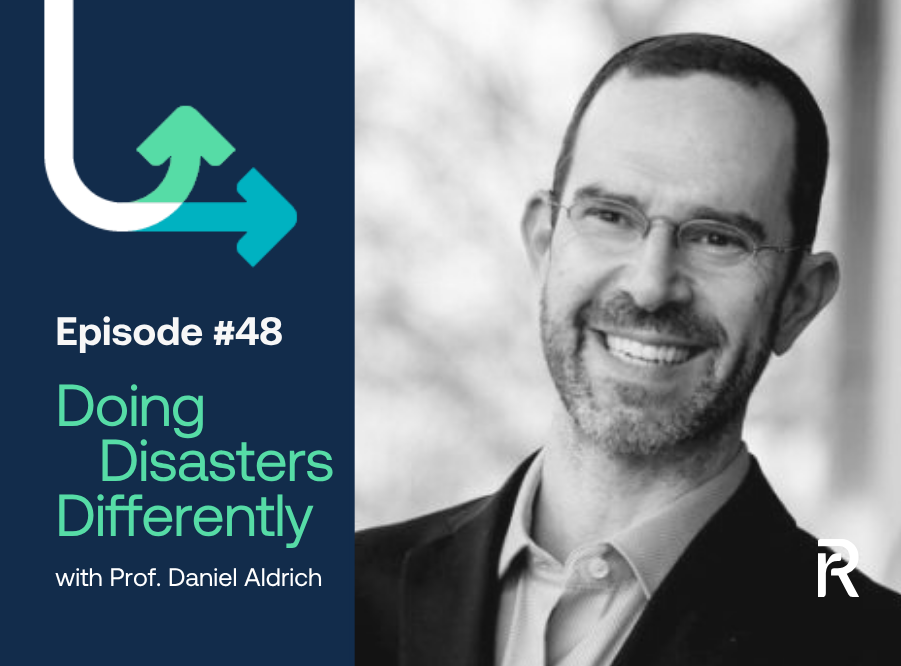
In this episode of Doing Disasters Differently, Renae talks with Professor Daniel Aldrich, a full professor at Northeastern University. They explore the groundbreaking development of a national framework for measuring social capital and social infrastructure in Australia, featuring insights from Professor Daniel Aldrich. Discover how these tools can transform community resilience, disaster preparedness, and everyday social cohesion.
key moments from the conversation
Daniel P. Aldrich was born in upstate New York and spent his childhood (and much of his adult life) travelling and living abroad. While living in Tokyo, Japan, he began to wonder how Japan – the only country to suffer the effects of atomic weaponry – could have built up such an advanced nuclear power program. He wrote up his observations in the book SITE FIGHTS published by Cornell University Press. In 2005 he and his family had their home, car, and all of their material possessions in New Orleans destroyed by Hurricane Katrina and began studying what makes communities and neighbourhoods more resilient.
He published BUILDING RESILIENCE to share these insights on the role of friends, neighbours, and social cohesion after a crisis. After Japan was hit by the devastating triple disasters of an earthquake, tsunami, and nuclear meltdown in March 2011, Aldrich wrote BLACK WAVE about the factors that helped people and communities bounce back.
I met Professor Aldrich seven, eight years ago when he presented in Australia.
And I heard what he was presenting on and I was like, that is totally aligned to what we’ve been trying to do. So I stalked him through LinkedIn and asked him to be a volunteer advisor on our Resilient Ready advisory group, which he very kindly said yes. And for the past five to six years, we’ve been working on projects to build social capital and social infrastructure measurement in Australia.
1. So we did it. We built a national framework to measure social capital and social infrastructure. I don’t know if you can see that in Australia. Nope, that’s not going to work. I’ll do that again. So we did it. We built a national framework to measure social capital and social infrastructure across Australia. So from your perspective as a global expert, obviously, in this space, why is this such a breakthrough?
Daniel Aldrich
Yeah, a lot of scientists and decision makers around the world care about the idea that our connexions matter and where we build them matters. But few have taken the time to really build a framework for systematically capturing it. If you read in the academic literature, usually it’s one neighbourhood or one city at a time. There’s a bunch of articles that do that kind of work.
And typically people like, whether it’s in Sydney or Melbourne or the New South Wales, those are territories that work by themselves. What Resilient Ready has done under your leadership is build a national, nationwide process. That means anyone across Australia can use the tools that you’ve developed and capture bonding, bridging and linking ties.
and then also look at the social infrastructure density, how many people nearby and where they meet. So that is a radical change from each state or each city works by themselves. Now we can compare Sydney and Adelaide. Now we can look at Darwin and Perth, right? Now we can look at areas like Hobart, areas that might not necessarily normally be on the same map together, literally.
Now we can bring them together in one place.
2. So now that we’ve got a framework, but we’ve also got a global first measurement tool, Sociabli for Australia, how do tools like that and the framework, how do we change it now? How can social capital and social infrastructure be part of what we do every day.
Daniel Aldrich
Yeah, this is the crazy thing. You know, this map that we’ve built can literally integrate with any other mapping system that’s out there. So imagine a health department in Australia that wants to know how do, for example, deaths from overdoses, or how do successful marriages, or how do low divorce rates, where do they come from? Do they connect to these kinds of issues?
Or if they want to know what difference does it make if there’s more or fewer parks nearby or more or fewer businesses nearby? How does that change things, right? So these maps integrate literally with anyone out there with a GIS mapping tool, ArcGIS, QGIS, this information and data can be used in any of those systems. And that means any question you have that can be mapped. Right? So again, if you just want to know for yourself, am I living in a community that has more or less access to what we’re calling social businesses, cafes, I would say Karaoke bars, but those aren’t so popular. We did find one, if I believe correctly, we did find one in Sydney though. So places where we can meet together, pubs, you can find out, or maybe a new business wants to open and wants to understand.
Is this community one that’s already quite rich in these facilities, or is it one that could use another one? So our thing has business applications, it has health applications, governments looking to a program. Let’s say you want to know, I only have a certain amount of resources. I can’t make everyone better off. Who might need those connections the most? Who might be the, in a sense, the coldest of the cold spots?
And that we can immediately find with this process, it tells us where the communities where connexions are weakest horizontally or weakest vertically. And that’s information until now that you had to guess at or sort of estimate by just driving through. Now we can compare community X to community Y all the way down to the SA1 block level, which is the most resolution we can get in a mapping system in Australia.
3. What was the top of the list of social infrastructure upon all the communities that we went to?
Daniel Aldrich
Pubs, if I remember correctly. Yes. So places to drink together, places to make those friendships.
One is I think for us to really imagine what kind of place do we want to live in, right? When we think about our daily lives in Australia or wherever we are, New Zealand, America, UAE, what makes our lives worth living? Like what gives us meaning? And the more I’ve been thinking about this, I realise it really is relationships. So to see how important social capital is,
All the time, again, not just throwing shocks and disasters, floods and fires, but on a daily basis, how much difference, how much better I feel with a neighbour who knows my name, someone I can trust with my key. If there’s a fire nearby, they’ll help me get out of my house. And all those things have happened, everything I just mentioned, in our neighborhood. So that’s one thing I would encourage everyone to think about, how important these ties are.
And the second is, why don’t we take them more seriously than in policy, right? If we have all this work that we do, all this money that we spend on organising roads and building zones and schools and everything else, why isn’t this invisible network something that we talk about more? So maybe we do see in Adelaide now a call in health, which is a great start.
But why wouldn’t every city, every town, every small place, really surface, bring to the top this idea that what makes our community better, make people walk at night because it’s safer. They know their neighbours and then therefore they leave the homes more often. They know the businesses nearby and they shop there rather than online. They want to support school kids nearby so they help them go on school trips.
All these things improve the quality of life. Let’s make social capital a part of our policies.
Connect with Daniel Aldrich