This episode
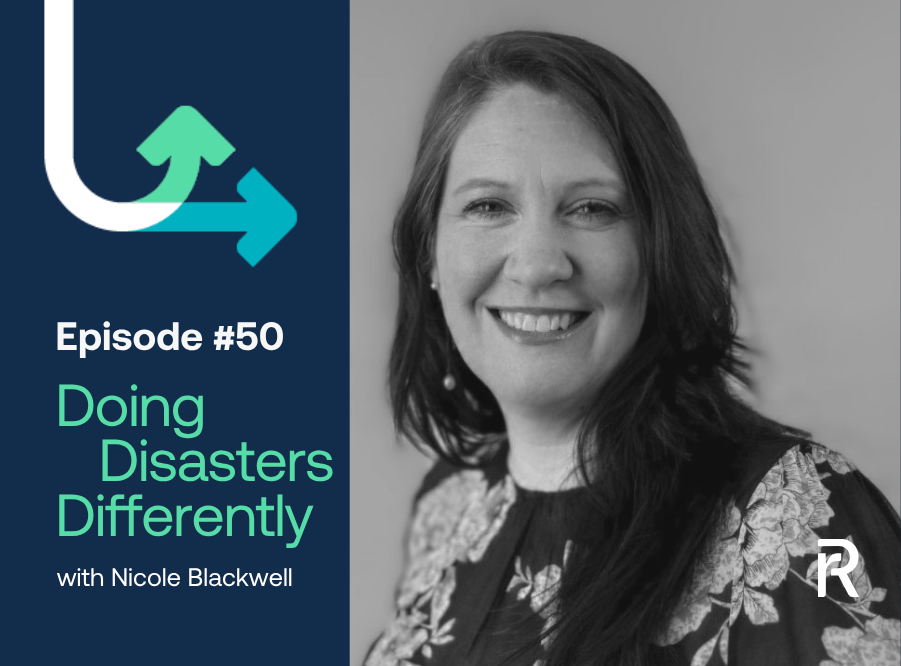
Today’s guest is Nicole Blackwell, an experienced emergency management leader working at NBN Co, helping strengthen preparedness, response and resilience across complex systems and critical infrastructure, and we’re talking about strengthening resilience through connectivity.
With deep expertise in emergency management, stakeholder collaboration and cross-sector coordination, Nicole sits at the intersection of technology, connectivity, and community resilience – working to ensure critical services and partnerships are ready when disruption strikes.
She also contributes to the broader emergency management community through her involvement with organisations such as Red Cross and Safe Australasia.
key moments from the conversation
Nicole Blackwell is a senior emergency management leader with 25+ years’ experience supporting people, organisations and communities through high‑pressure, high‑consequence environments.
Her career began in Information Technology and database administration, grounding her in systems thinking, analytical clarity and the importance of good data in decision‑making. That technical foundation continues to shape how she leads – with clarity, evidence and a focus on what helps people perform well when it matters most.
Over time, her work evolved into national emergency management and organisational resilience. She led and supported responses to major, all‑hazards events – including Black Summer, COVID, floods and cyclones – working across emergency services, government and critical infrastructure partners.
In her current role as National Emergency Integration Manager at NBN, she’s trusted to hold the operational and executive layers together during system‑wide emergencies. She translates complex, multi‑agency and technical issues into clear, actionable information that enables calm, confident decision‑making under pressure.
She’s a people‑centred leader who deeply values culture, capability and relationships. She designs and delivers training, exercises and development programs that build confidence before it’s needed, and she coach leaders to show up with presence, clarity and care during uncertainty.
I first met Nicole back in 2019 during my corporate2community days, when our paths crossed while trying to coordinate some cross-sector initiatives.
While those ideas didn’t quite get off the ground at the time, one thing that stood out was Nicole’s enthusiasm for collaboration and genuine interest in connecting sectors to do preparedness and resilience differently.
1. Nicole, you sit in a really interesting space between emergency management, critical infrastructure and connectivity. What does your role involve and why should people care about emergency management inside an organisation like NBN?
Yeah, I really sit in a space between emergency management communications in the technical sense and then community connectivity. So my role at MBN really means that I try and make sure MBN is showing up in the right ways for community before, during and after events. And when I say that, it’s not about that we’re responding like an emergency service, it’s completely different aspect of it. So it’s really making sure that people have clear trusted information at their fingertips about their connectivity, what’s happening, what to expect, and then what they themselves can do, whether that be as a resident, a business, a small business owner, or working in a major enterprise, whatever part of that community that they sit in or parts as we all do. But really, I think why should people care? People should care because connectivity is really how we live our lives these days.
It’s how we access information. It’s how we speak to family and friends. It’s how we do our work. It’s how we pay our bills, all those sort of things. So when something goes wrong, it can feel really stressful and confusing because it’s not life as we know it anymore. So yeah, my role at NBN is really trying to coordinate and share that information about what people can do to be prepared for any sort of emergency event, to make it easier to get through that event. I mean, it’s not going to solve all the issues, but get through that event and then recover on the other end and come out stronger.
2. Connectivity has become essential infrastructure — for warnings, banking, health, business operations and staying connected to loved ones. How has the role of telecommunications changed in disaster preparedness and response over recent years?
It’s changed a lot as you’ve just highlighted there. So it used to be a more of a nice to have part of our day. You get on, you check some emails or you text somebody or just get an overall understanding of what’s going on and then move on with your life.
But now communication feels critical to everything. And as you mentioned, it’s warnings, it’s health, it’s banking and that most important bit, particularly in emergencies, is that staying connected with family and friends. That’s where it really gets me and that’s why I’m so passionate about this space.
3. What are some of the biggest misconceptions people, organisations or communities have about staying connected during disasters — and what should they be thinking about now?
I think one of the biggest things is that expectation that the internet and communication should just be working no matter what. That isn’t a reality because we do rely on that physical infrastructure. So that equipment itself, not just on the NBN network but in the user’s premise, so at the businesses or at the home, that needs power as well. And if any of those or a combination of those or any combination of those are impacted by fire, floods, storms, bike loans, whatever it is that we seem to receive in this country, services can be disrupted. Another, I suppose, misconception is that restoration is always going to be quick and predictable, the predictable bit. I tend loads of different sessions where people say, “Well, how long is it going to take?” And it really is, how long is a piece of string? It depends so much on what the situation is at the time and in emergency conditions, access and safety and power restoration, they all play a big role.
So what should people be thinking about? So there’s a couple of questions really. It’s how they’ll stay informed if power or connectivity is disrupted. And think about that before you know, okay, power’s gone out, calms are down, this is what I’m going to do. It’s like having a fire plan or a flood plan. This is your comms plan. What backup options do you have? So if plan A doesn’t work, where’s my plan B, D, and I’m very much a planner. I’ll have A through Z and then maybe start again to AA and double Z. Me too. But then also just understand what the telcos like other utilities. We are working to restore services as quickly and as safely as possible. I know that firsthand because we’ve been involved in so many of those events around the country and we are genuinely working hard for communities to try and restore things and sort of return that normality out of the chaos from whatever the event has given us.
4. From your perspective, what does good preparedness look like for organisations operating critical infrastructure? Is it plans and systems… or is it really about people, relationships and culture? Or both?
Good preparedness. It’s one of my favourite topics. I’m so glad you asked that question. It’s exactly what you just explained then. You need strong plans and partnerships, but more than that, you need to have tested those plans and those partnerships. So you don’t just write it up and have it pretty glossy brochure or something sitting on your bench. That’s great too. You have to test it because guaranteed things… Plan A is great, but it probably won’t work all of the time. You need to have those plan B, plan C, plan D. It’s like a choose your own adventure type storybook that I used to love when I was a kid. So you’ve got to really test those. And from my perspective, I think the difference in an emergency really comes down to one, trusting those plans that you have and also your relationships with governments and emergency services and your local community exactly as you just called out.
So it’s building that trust before the event, having clear roles and decision making. So I know who to pick up the phone and call or I know who to, and this is beforehand, I know who to make those plans with before so that if the comms and power goes out, then I’ve got that plan and I can follow and execute on that. And it’s also the testing bit also tests how people work together under pressure. If you can have a realistic scenario test, then you can start seeing where people’s strengths are and if you need to take a bit of a breath every now and again, you can absolutely do so. But that testing is so critical because when you come to do it in real life, it’s not going to become in any way, shape or form. So you need to have that confidence in what you’re doing and the confidence in that you have options.
I think that helps. So those plans themselves give you a starting point, but yeah, it’s really those people, those relationships and the culture that makes it work when things don’t go to plan.
5. Disasters are becoming more frequent, complex and interconnected. What are some of the emerging risks or challenges keeping emergency managers awake at night?
We work all the way across the country. So we see all sorts of different emergency events from cyclones up north to fire flooding down south and everything else in between. And it’s not just one event happening that you’re sort of dealing with. There’s often cyclones in the north floods down in the west and fires happening somewhere in the south. That’s happening at the same time. So it’s about managing all those different things all at once, which is really challenging the longer durations. Again, people get fatigued very, very quickly and when you’re fatigued, your decision making process gets diminished rapidly. So it’s about looking after your emergency management teams and your liaison officers and the people on the ground. How do we keep going through these events that continuously keep coming at us? And then the biggest thing I think for community perspective is the cascading impact.
6. How do you plan for connectivity resilience when disasters themselves are becoming more frequent, complex and overlapping?
I think that you’ve always got to plan for what you haven’t planned for at the moment. It’s not necessarily thinking in terms of events anymore. We really work on continuous preparedness. So we’ve got this campaign that we call EM365. So we’re literally every single day of the year we are thinking about emergency management and that really means, yes, planning for all those different types of hazard and impact, but more than that, it’s relationships. So staying connected with local communities, emergency services and governments, all levels of government from local government through to federal all year round. It’s not just about the events. The events, how well you go and restore in those events actually all the hard work you’ve done before that will determine how well or how you succeed. So it’s the preparation that is absolute key. So having that consistent approach with how we communicate before, during and after.
So they’re my favorite words, before, during, and after. But yeah, all the work you put in before means that the during and after won’t be so hard. So yeah, it’s less about predicting exactly what will happen or where it’s more about being ready to respond in that coordinated consistent way when it does.
7. What lessons has the telecommunications sector learned from recent disasters about preparedness, recovery and supporting communities under pressure?
I think for me speaking last four or so years in the telco sector, clarity. Clarity really matters. So people need simple factual information, especially when things are uncertain. Now that’s not necessarily easy because it is different for every community, but it’s also different for every person within that community and then it’s different for every person as a resident or every person as a business owner or every person as a school student or whomever you are because you have multiple roles within a community. So clarity really matters. Consistency I think is probably the next thing. So mixed messaging, particularly across those different organizations and there’s so many different organizations that are there helping in an emergency event. So that can create some confusion. So trying to get some consistency there is really important partnerships that helps
Get the consistency going so we don’t do this alone. It’s a coordinated effort across utilities, governments, industry, emergency services, agencies, the local GP, like I mentioned before, it’s actually about all of us together and then expectations matter as well. And this is where all that work beforehand. So helping people understand what it looks like, that can reduce so much frustrations during outages because if people know and understand that this may be coming and they’ve prepped for it and they’ve given themselves options, it’s less frustrating at the time. I think what we’ve really learned is that communication is just as important as the technical response in an emergency.
Okay. So first and foremost, it is about tapping into that community. So focus more on community understanding. We have some amazing people in all of our communities around the country who know what’s best for their communities. So there’s still really that gap in how people understand telecommunications. And I get it because telecommunications is incredibly complex. There is no simple answer and it’s very technical. So how it actually works, what can impact it, how restoration happens, that all differs depending on where you are and what technologies you’re using. So helping to close that gap would make a big difference during emergencies. And we are working now to get some better industry communications out there to try and help close that gap. So that’s probably the first thing.
And yeah, that second thing is that stronger alignment across industry. So having that communications from the telco industry rather than the individual players within it can really help because people can then understand the general telco world without needing to go into the nitty gritty, which people… I mean, I love it. I’m a tech nerd, but not everybody does, so that’s perfectly okay. So helping people understand that and then communicating that in a consistent way will reduce that confusion and really just help people, help communities, help businesses, help residents make better decisions during stressful situations. That’s really the key. So I think we’re doing this pretty well at the moment, but there’s always room for closer coordination. And then I think the bit we’re not doing so well is then educating the community around what we are doing. So that’s what we’re sort of focusing on at the moment.
Connect with Nicole Blackwell