This episode
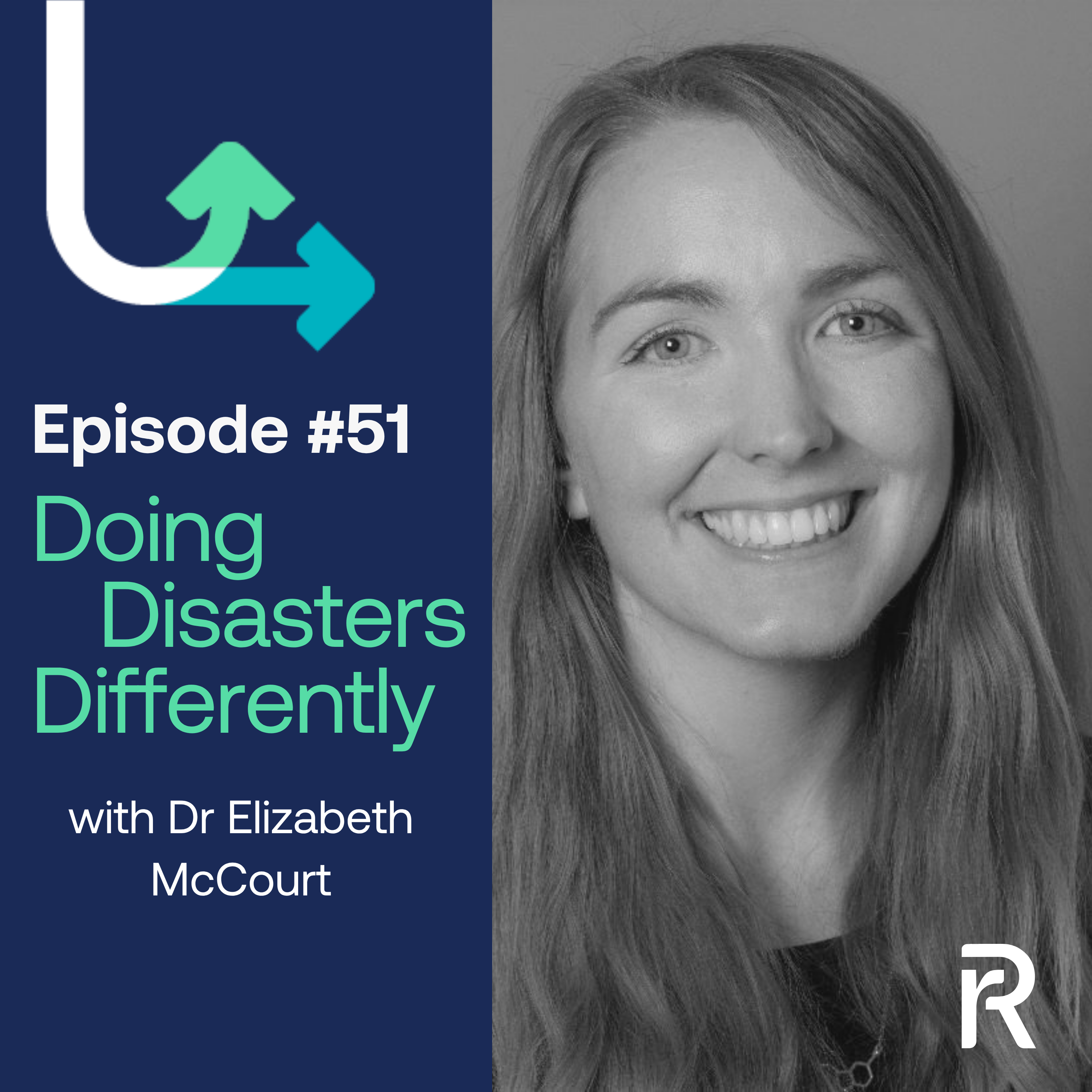
In this episode of Doing Disasters Differently: The Podcast, host Renae Hanvin speaks with Dr. Libby McCourt about the critical role of pharmacists in disaster preparedness and response. She shares insights from her research, experiences during disasters, and how the healthcare sector can better integrate pharmacists into emergency management systems.
key moments from the conversation
Dr Elizabeth (Libby) McCourt is a clinical pharmacist, researcher and disaster preparedness expert whose work has helped shine a light on the critical role pharmacists play before, during and after disasters.
Her PhD examined the preparedness of Australian pharmacists for disasters and emergencies, and following deployments during events including Cyclone Debbie, her research has focused on strengthening disaster preparedness, pharmacy practice and the integration of pharmacists into emergency management systems.
She is passionate about ensuring one of Australia’s most accessible health professions is recognised as an essential part of disaster resilience.
I met Libby quite recently as we’re both part of an Expert Advisory Group for a resilience project being delivered by the Pharmaceutical Society of Australia in the ACT.
As many of you know I LOVE pharmacists and chemists given their critical role in community wellbeing and the role they play in connecting communities.
So as soon as I heard about Libby’s experience I clearly decided we had to become professional best friends.
1. Libby, for people who have never really thought about it before… what role do pharmacists actually play before, during and after a disaster? And what’s the difference between a pharmacist and a chemist?
Yeah, great question. And I think pharmacists are a little bit of the unsung heroes of health response to disasters. They have so much that they can do before, during and after. One of my colleagues who I work with quite closely on a lot of disaster stuff is Dr. Caitlin Watson, and she did her whole thesis on the roles pharmacists can play in disasters. And she identified 42 roles, and that was before the COVID pandemic. So I’m sure there’s a lot more added on now.
Pharmacists in the community are usually a central point of people’s health. Like you said, one of the most accessible health professionals in our communities. And so they see everything from small kids to older adults and everything in between. You see those people who come in who’ve had skateboard accidents who just sort of mosey into the store and you help them out with patching them up.
So in terms of before a disaster, have an important role to play in teaching people how to be prepared for a disaster, like
Would you respond if you got evacuated from your home? Would you be ready in terms of your medicines? I think whenever we’re thinking about being evacuated, we often think about getting the dog, getting the kids, getting the photo album, but we don’t necessarily think about ourselves and our health. And what are you going to do if you forget to bring your anticoagulant along with you? Chances are you miss a few doses and you might end up in hospital with heart complications, which would be awful. So there’s a really important role in that before.
During a disaster, think I’ve talked to so many pharmacists who have tried to maintain the operations of their pharmacy and just being there to provide people with the medicines they need, give health advice and make sure that people are keeping safe and well in a disaster. So I know that in Brisbane whenever we were doing flood cleanups like pharmacists were there giving out disinfectant buckets like this is how you stay safe while you’re helping with cleanups. So there’s just like so much pharmacists can do all the way from acute care to chronic disease management.
2. Your PhD focused on the preparedness of Australian pharmacists. What surprised you most during your research, and what did you discover that the rest of the emergency management sector needs to hear?
Whenever I did my PhD, I think there was two things that really surprised me and that really related to the internal piece and being personally prepared yourself and even thinking about how you would respond to a disaster, which it sounds so inherent, but it wasn’t necessarily something I’ve thought about before. And how do you think about disasters yourself. Like if my house was to be threatened by bushfires, at what point am I evacuating? At what point am I not going to work? And what point am I X, Y, Z? So really that internal pace, but also the supports around you played a really important role in pharmacist preparedness. So if I worked in an environment where I didn’t feel like my colleagues were ready, like my boss cared, like people in the community needed me to be there, I was less like, to be prepared which was really surprising and it wasn’t necessarily Having, well, experience does help, but like knowing that you can rely on a team and knowing the people around you are prepared. Increase your own preparedness, regardless of whether you have experience in a disaster or not, which is really surprising, but makes so much sense in a disaster because I think that social cohesion is something that pulls us through and helps recovery as well, like helps our communities to recover from a disaster. So I found that surprising at the time. And then on reflection, I was like, why am I surprised by this? Of course, would be the case. And I think as well that external, almost government level of preparedness.
is an important piece in how prepared pharmacists can be. So we can be open for our community, we can be there, but we do need government support to be able to do that. So many years ago, whenever I was speaking to pharmacists about keeping their pharmacies open and operational, a lot of the feedback that I got was that they weren’t deemed an essential service. generators would go to the GP clinic, which is fantastic, the GP needs lights on too.
they need Electricity be a right script, see people, see what they’re doing. But then the pharmacy was told that they weren’t an essential service. So then we have scripts coming from the GP to the pharmacy and the pharmacist is there by torchlight, trying to like write out the labels and pick the right medicine and all of this sort of carry on. So it’s really funny to have one as essential and the other not when they’re so intertwined and reliant on each other to because the doctor can sit there prescribing all day. But if your pharmacy is not open to supply the medicine, then there’s no point in doing it really. And vice versa, the pharmacy can be open all day but if they don’t have a GP to refer people to or to get scripts from then they are limited in what they can do. They can do stuff but like not as much as they can with our medical colleagues there.
3. Pharmacists are often one of the only healthcare professionals people can access quickly during a disaster. Why do you think their contribution has traditionally been overlooked in emergency planning?
I think it has changed a bit. Whenever I finished my PhD in 2019, so a very auspicious time to be finishing a PhD on disaster preparedness, I think that pharmacists weren’t recognised as much. And I think primary care in general was quite underappreciated. I think when people thought of disasters and emergencies, they immediately thought of hospital response, not realising that most people are walking well as we describe and often go to their primary care physicians and the pharmacy and those establishments mean to be well prepared in order to avoid people having to go to the hospital and causing bigger problems and higher costs to the health system and getting into more strife themselves. Like if you can go to the pharmacy and sort out your pain medicines, then you don’t have to fall over and hit your head and end up in the emergency department with bad outcomes. So I think it has changed since then. And I think it’s been a combination of COVID and of people sharing and recognising their stories from primary care. I think this is something that I see a lot in disaster management is I’ll speak to GPs or pharmacists or nurse practitioners working in the community who’ve responded to disasters in their community, floods, earthquakes, whatever it is. And when you say like, who have you shared this with? And they’re just like, well, it’s just the work I do. Like a pharmacist, of course, I’m going to be there for my community. So they don’t necessarily think to publish it or share it with a news outlet or anything like that.
I think in terms of getting the word out there that these are important health professionals to be in the community and to be open and operational and disaster. think that was probably one of the big things, but I think we’re getting better at sharing those stories and recognising. And I think COVID has played a role in that.
4. You were deployed following Cyclone Debbie and have also studied disasters across Australia. What are some of the biggest challenges pharmacists face when communities are isolated or healthcare systems are disrupted?
I think there’s a lot of them. So pharmacy and is and should be a quite a tightly regulated profession. We’ve got a lot of rules around, for example, a pharmacy can’t open without a registered pharmacist there. So even if every other staff member can get to the pharmacy, if the pharmacist isn’t there, you cannot open and operate. We also have very strict rules around how we store medicines, how to move medicines, how we can let medicines leave the pharmacy.
And so there’s a lot of regulation, and again, as there should be, that just becomes exponentially more challenging in a disaster. So if you can’t pick up all your drugs and move them pretty easily, which we can’t in pharmacy because we’ll often have controlled drugs, we’ll have things that need to be stored in a fridge at tight temperature ranges.
There’s a lot of operational challenges with that sort of work. And then there’s just the everyday stuff that comes with the disaster. We’re very reliant on electricity. Some of my older pharmacy colleagues remember having to write out or type out on their little typing machine patient labels.
And then of course, the internet, we need our internet for our claiming of our medicines to see what history patients have to see what drugs they are. Pharmacists do generally if you say, it’s the little one that sort of smells like peppermint, we know what you’re talking about. lot of little white pills that don’t smell like anything. identifying what drugs are, what people might be on.
But there’s a lot of operational challenges that we have as long as well as all of those sort of personal ones like can you actually get into work who’s looking after the children is the house okay like there’s just so many levels to it and then there’s also so much that you can do with reduced staff so there may be some pharmacists that work in community where they’re the only staff in that community but there may be some pharmacies where they have five or ten people on at one time and if you’re cut back to yourself one other person. What services can you provide realistically? Like how many scripts can you do whenever you’re handwriting everything out? So there’s a big slowdown in operations and then communication is a big one too. Again with power out, with phone lines down, how do you communicate with your doctor down the road and say hey Joe Bloggs is here and he needs his script for x y and z or we want to supply him with this medicine or we’ve run out of this one but if we change the dose slightly we could change him to this one. what do you think? These are all just like challenges of working in healthcare
5. If you could change one misconception about pharmacists in disasters, what would it be?
They can be there and they can help. Like I think a lot of people, probably their biggest misconception is that they haven’t even thought about it. So, it’s maybe not necessarily a misconception, but just you don’t know what you don’t know. So yeah, pharmacists can be there. They can help. They can work in evacuation centres, helping to get medication lists. They can work in pharmacies, treating minor injuries, getting people the medications they need, providing advice, even stuff like telling people how to store their medicines in a disaster, how to look after their health in a disaster. So there are a lot of impacts of disaster that don’t mean you need to go to the emergency department, but they are very uncomfortable and can develop into something more serious like sore throat, sore eyes, shortness of breath from like inhaling smoke. Like how do you manage those things and then escalate them when appropriate? I think, just that pharmacists have a great role to play.
I think that really collaboration across community and tertiary. I would love to see primary care, GPs, pharmacists, hospitals working together on a coordinated response. It doesn’t make sense for the hospital to respond in one way and the community to respond in another.
They are so interdependent on each other. Something can be managed in community. It’s going to hospital. If the hospital is too busy, people are running out of that ED and going straight to the community. So we really need to make sure they’re preparing together, getting on the same page and sharing resources. I think that’s probably like 80 wishes in one. So I might leave it at that.
Connect with Dr Libby McCourt